
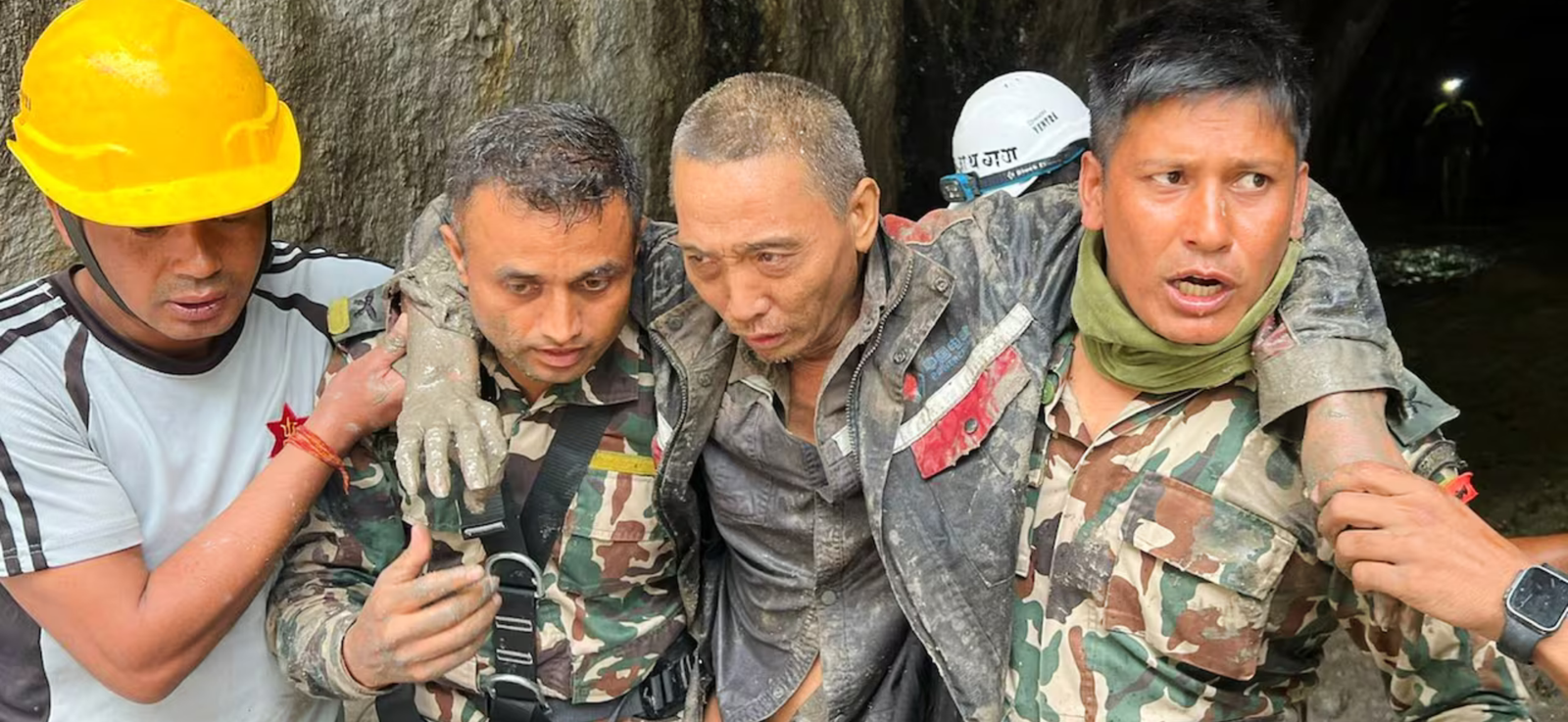
A Chinese worker was found alive in a Nepalese hydropower tunnel that had caved in. This was 10 days after a massive glacial flood tore through the borderlands of the Himalayas, burying entire communities under ice, rock and mud. As of Saturday, the Nepali Army confirmed the rescue. It is a rare and welcome sign of hope in a disaster that has already claimed the lives of more than a thousand people and left thousands more missing.
Someone Who Was Pulled From the Dark
Authorities named the guy as Lu Haitao and found him still alive in a 225-meter tunnel at the Upper Trishuli-1 Hydropower Project in northern Nepal. This is one of many hydroelectric sites that are spread out along the Trishuli River. Rescue workers had been working nonstop to clear the area and get to workers who were thought to be trapped deep inside the mountain. It was a huge step forward for Lu’s recovery after more than a week of bad news.
Just the day before, two workers were found alive in a different tunnel at the Upper Trishuli 3A Hydropower Station, which is also on the Trishuli River. This rescue came hot on the heels of another amazing find. One of them was mechanical supervisor Kabir Maharjan. He was reunited with his family who were overjoyed to see him again after being without food, water or any news of where he was for almost ten days. Reporters asked his wife to describe how, during the ordeal, they had barely been able to eat or sleep and how happy they were that he was still alive.
First responders say they think there may still be survivors living in other parts of the tunnel network. Experts have held out hope that the trapped workers could stay alive for a long time because some of these hydropower tunnels go for kilometers underground and have rooms, equipment stores, and pockets of breathable air. Searchers continue their search, but concern is rising over dwindling air and water supplies.
The event that caused the crisis
The rescues were caused by a sudden and violent flood on August 26 near the border between Nepal and Tibet. Nepali officials and Chinese state media say that the disaster began when a glacier high in the mountains broke off. This sent a massive wave of ice, rock, mud and water thundering down the valleys of the Bhote Koshi and Trishuli rivers. Homes, roads, bridges and cars were washed away in seconds in Nepal’s Rasuwa and Nuwakot districts and parts of Tibet.
Damage on this scale is unbelievable. Authorities in Nepal and news outlets around the world say that the death toll has risen to over 1,300. Thousands more people were reported missing right after the disaster, including many foreign tourists and pilgrims who were traveling through the area, some on their way to or from Mount Kailash in Tibet. The government of Nepal says that the flooding and landslides have affected more than 84,000 people across the country in some way. The UN World Food Program says that about 43,000 people, or about 10,000 families, need immediate humanitarian help.
Glacial lake outburst floods occur when a natural dam of ice or debris containing a glacial lake fails, sending a wall of water and sediment downstream with little or no warning. Researchers are worried that this isn’t the first time something similar has happened. About 14 months ago, rising temperatures caused a glacial lake in Tibet to overflow, killing several people and damaging a border bridge. This was in the same river system. Scientists view this as an indication of how fragile the Himalayan ice system has become, raising the danger to communities, infrastructure and water supplies in one of the world’s most densely populated areas.
Still Hundreds Locked Up in Hydropower Tunnels
A big part of Nepal’s current rescue efforts has been focused on the hydropower industry, which has a lot of operations along the Trishuli River corridor. The flood may have trapped several hundred workers in tunnels that are linked to at least six hydropower projects in the area, according to officials. Two-thirds of the missing workers were thought to have worked on the Upper Trishuli-1 project alone. At Upper Trishuli 3A, the number of missing workers is thought to be in the hundreds, with more than one hundred thought to be trapped in the facility’s main tunnel.
The problem that relief teams have had to deal with is huge. Reports say that some hydropower plants were completely destroyed, with their outer structures being so badly damaged that they can’t be recognized. Teams have therefore had to rely on satellite imagery and professional mapping to find tunnel entrances buried several meters deep in hardened mud. Nepalese officials hired experts from around the world, including an Australian tunnel-rescue engineer who has worked on major underground disaster responses before, to help with this very hard work. His knowledge helped teams know where to dig to get survivors out as quickly as possible..
A response from across the globe
Many people across the border came to help, especially from China, where the disaster took place and many Chinese people were affected. Several days after the flood, the Chinese government sent dozens of tons of emergency relief goods to Kathmandu on military transport planes. Nepal’s disaster relief fund also got millions of dollars in aid from Chinese diplomats, with more help coming through the Red Cross Society of China. Afterward, Beijing sent teams of tunnel-rescue experts and forensic experts to help with the search and recovery operation. They also helped repair infrastructure on its side of the border damaged by the flood in the Gyirong Port area that had cut off roads, power and communications.
Responses have not been limited to government channels. And there were private donations as well.
One well-known technology executive gave $10 million to Nepal’s official disaster aid fund. Cooperation across the border has also helped stuck travelers on the ground In the past few days, more than 200 Nepali citizens who were stuck on the Chinese side of the border were taken home, with some using a makeshift zip line to get across damaged crossing points where bridges had been destroyed. Many were pilgrims or business travelers.
A Wavering Hope in an Ocean of Grief
Every time there is a rescue there is a fragile cocktail of hope and sadness for the families of the missing. The successful recoveries of Lu Haitao, Kabir Maharjan, and others have been some of the few bright spots in a very sad story for the region. But they also tell us how many are still missing. Aid groups have warned that the longer the searches go on, the less likely it is that more survivors will be found, even though rescuers are still digging through the wreckage in the hopes of making more progress.
Now Nepal has the hard work of long-term recovery ahead, including rebuilding roads and bridges washed away, repairing power infrastructure, resettling families displaced from their homes and figuring out how to pay for damage to the hydropower sector – a key part of the country’s energy infrastructure. Given how fast and violent this one was, and the disturbing pattern of events repeating themselves along the same river system in recent years, scientists and disaster management authorities are probably under increased pressure to improve early warning systems for glacial lake outburst floods.
But for now, the story of a person found alive after 10 days trapped in darkness deep inside a mountain tunnel is a stark reminder of how tough people are in the face of one of the deadliest natural disasters to strike the Himalayan border area in years.
The data in this article comes from reports from the Nepalese and Chinese governments, as well as news outlets and disaster relief groups tracking the situation. The death toll and the number of people missing are subject to change as search and recovery operations continue.