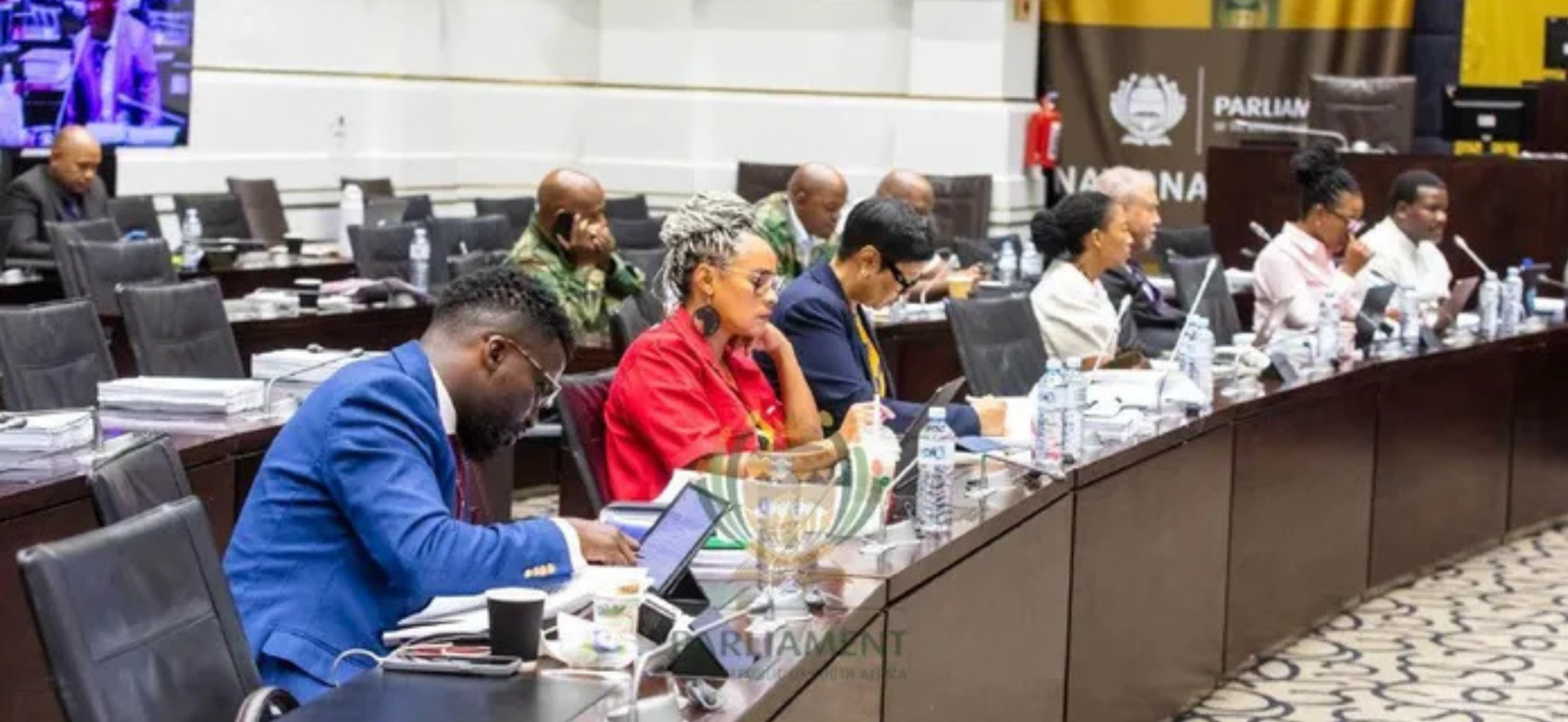
On Thursday, September 4, 2026, a virtual meeting of Parliament’s ad hoc committee looking into charges of corruption in the criminal justice system descended into a shouting match, forcing members of the DA and ActionSA to leave the meeting entirely.
As the committee convened to work through its draft findings, tensions erupted over a well-known point of contention: the decision to not call former SAPS deputy head of crime intelligence Feroz Khan to testify. There is pressure on the committee to provide its final report to the National Assembly by September 11th.
A Conflict That Had Been Building
The committee has been plagued with the Khan matter for days. The MK Party had already accused the committee of “colour-coding” its corruption report, implying that conclusions were being softened or rearranged to shield certain personalities, just three days prior to Thursday’s explosion. Almost immediately after Thursday’s meeting began, that complaint reappeared, with MK Party leaders reiterating that Khan ought to have been asked to testify and implying that other committee members were protecting him from examination.
The claim infuriated Ashley Sauls, an MP for the Patriotic Alliance, who fiercely defended his party against what he called a trend of MK Party members disparaging it in public. Sauls proclaimed, “I will not be intimidated by the MK Party,” referring to the repeated charges against his party as “nonsense” that had endured for too long.
Sharp Words to Standoff
The conversation quickly became out of control. “I’ll attend to you personally if you say nonsense,” said MK Party MP Vusi Shongwe, who objected to Sauls’ language choice and accused him of using foul language against MK Party members during a parliamentary session. In a room where decorum is rigidly maintained, this is a serious accusation. “That’s swearing,” Shongwe declared, making it clear that he would not disregard the problem.
Sauls refused to back down, claiming that Khan had never been shielded from responsibility by the Patriotic Alliance. Members of the MK Party, however, were not finished. They persisted, claiming that footage from earlier committee meetings would show Sauls’s earlier rejection of Khan’s testimony, accusing him of being inconsistent, if not dishonest. Sauls denied the allegation and urged Shongwe to release the recordings if he believed them to be authentic.
By this point, what had started out as a procedural disagreement over a single witness had developed into a heated and personal fight between two MPs, neither of whom was willing to back down.
Two Parties Leave
As the argument continued, other committee members became clearly irritated at seeing two coworkers argue over one another rather than completing the report. The first person to reach her breaking point was Dereleen James of ActionSA, who told the meeting that she could no longer stand the spectacle. “I cannot be part of this,” James said, pointing out that South Africans were waiting for a credible outcome and that MPs on the committee had already sacrificed a great deal of personal and family time to see the process through. She described the situation as “embarrassing” and departed the virtual meeting, instructing the committee to call her back when things were back to normal.
Almost instantly, the DA followed. With a sharp parting statement, MP Glynnis Breytenbach said that her whole party delegation would also be leaving the meeting, saying that the committee should “call us back when these two are finished squabbling.”
Without Them, the Meeting Continues
Surprisingly, things didn’t get much better when two parties left. Even after DA and ActionSA members had logged off, the Patriotic Alliance and MK Party officials were still at odds, and Soviet Lekganyane, the chairwoman of the committee, chose to mainly stay out of it rather than take direct action to restore order.
The hands-off approach was attacked by the ANC benches this time. MP Khusela Diko attacked both rival parties and the chair’s handling of the matter, stating that the committee had just seen “utter disrespect for the platform of parliament from two parties” and that she was concerned that neither MP had received a formal censure for their actions.
ANC MP Xola Nqola expressed similar concerns, warning that the outburst would erode public confidence in the committee’s work at a very sensitive moment. He emphasized that throughout the discussion, members had “completely disregarded” the National Assembly’s policy mandating that they address each other through the chair instead of face-to-face. Nqola also highlighted the poor timing, saying it was heartbreaking that such a breakdown had happened so close to the committee’s final deadline.
Work Resumes, Order Restored
In order for the committee to resume its business, Diko and Nqola both demanded that the DA and ActionSA delegations be invited back into the meeting. They were successful in their appeal. The DA and ActionSA reconciled and the meeting proceeded when the MK Party apologized for its part in the disturbance.
Despite the chaos, the committee’s major objective is still to finish its report on corruption in the criminal justice system and deliver it to the National Assembly by September 11. Thursday’s episode is unlikely to be the last flashpoint before the report is finalized, given how contentious the Khan issue has already proven to be and how divided the committee is over how to represent its conclusions. There isn’t much room for delays on that timeline.
The events of Thursday served as a disturbing reminder of how fragile public trust in law enforcement authorities can be, both in the organizations under investigation and in the committee tasked with holding them accountable.